
AI in Healthcare
Artificial intelligence is becoming the silent co-pilot that helps healthcare professionals save lives.
The stethoscope took decades to establish itself as the universal symbol of medicine. In contrast, Artificial Intelligence (AI) algorithms have entered clinics at a breakneck pace, transforming how healthcare professionals detect, understand, and fight diseases.
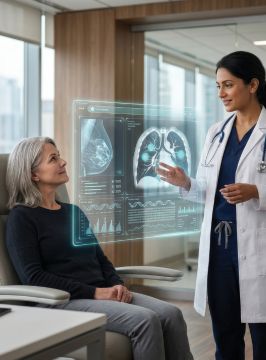
One of the areas where this impact is most evident is radiology. AI powered analysis of medical imagery allows for the identification of anomalies imperceptible to the human eye at very early stages. For instance, systems applied to mammograms or chest CT scans significantly reduce false negatives, which means gaining vital time in conditions like cancer, where every week counts.
The true paradigm shift, however, lies in personalized treatments. Traditional medicine usually applies standard protocols based on statistical averages. AI, on the other hand, can cross-reference millions of clinical data points, a patient’s genetic history, and lifestyle records within seconds to suggest therapies tailored precisely to each individual. This optimizes drug efficacy and reduces side effects.
Complex Challenges
Despite its advantages, the sector faces complex challenges. The privacy of medical records is the first major hurdle. Dr. Eric Topol, a renowned cardiologist and digital health expert, argues in his research for Nature Medicine that the widespread adoption of these tools requires an absolute shielding of patient identity. Medical histories are the most highly targeted objective for cyberattacks, threatening doctor-patient confidentiality.
Added to this is data bias, an invisible yet dangerous ethical issue. A meta-analysis published by The Lancet Digital Health revealed that most current diagnostic algorithms have been trained on populations lacking diversity, predominantly from high-income countries. Lacking data from ethnic minorities or vulnerable communities, the system may fail when extrapolating diagnoses to other geographical or genetic realities, thereby perpetuating public health inequalities.
Because of this, World Health Organization (WHO) guidelines insist on strict ethical regulation. Experts from this body assert that the future does not depend on absolute automation, but rather on a symbiotic model: the precision of the machine at the service of the healthcare professional’s intuition and humanism.



Ingreso a Webmail
Learning To Live Magazine Revista de Salud, Bienestar y Noticias
info@learningtolivemagazine.com
Telephone: +1 (786) 788-2064